
From Osuna with love.
-Hi! I’m from Osuna!
You may think “Ok! What do we care?” Well, maybe you should. If you are keen on history, this is just the right place. And hey, I’ve hidden something cool about this in Bird: El inglés volando.
Some quick facts:
- Name of the town: Osuna.
- Location: In the centre of Andalusia.
- Years old: 3000.
Three thousand! If you have thought about Tartessos, bingo! Osuna was part of the first civilization in the Western world (1200 B. C. – 500 B. C.). It is said that back then, Osuna was surrounded by forests of holm oaks and animals as big as bears (hence its ancient Latin name Ursus). The Phoenicians, and then the Greeks, come over here to trade with the Tartessians. The Phoenicians (current coast of Syria and Lebanon) loaded ships full of gold, silver, peacocks, monkeys, and sailed back to eastern Mediterranean areas. On the other hand, these traders brought olive trees, hens…

It’s very difficult to tell what’s factual and what’s mythology around Tartessos. Quickly again:
- Argantonius was a king: Fact.
- Baal and Astarté were our gods: Fact.
- Gerión had three heads and was the first king: Erm… I’d say it’s a myth, don’t you think?
- The Phoenicians were defeated by the alliance of the Etruscans (northern Italy) with the Carthaginians (northern coast of Africa), bringing about the end of Tartessos: Probably fact.
The Turdetani were the heirs of this culture for 5 centuries. Considered the most refined of all Iberian peoples, we had a language different from the rest of our neighbours and art here was particularly noteworthy. Top artistical expressions from that time have been found in Osuna, especially sculptures: Warrior Playing the Horn,Bull (guardian of a burial site), Acrobat, etc. You can see them in The National Museum of Archaeology in Madrid and in the Louvre Museum in Paris.
- 210 B.C.: The Romans arrive!
Their empire is getting bigger and bigger and they were particularly interested in places suitable for the farming of olive trees, wheat and grapevine. Gentlemen, you’ve arrived to exactly the right place.
A decisive battle takes place in Osuna between Pompeius and Julius Caesar (in person!)
- Name of the battle: Munda.
- Date: 17th march, 45 B. C.
Caesar wins and Osuna is declared Colonia Genetiva Iulia. The laws of the town are engraved in four bronze tablets (National Museum of Archaeology, Madrid). The emperor Augustus grants Osuna its own coat of arms. And here we come to the secret I wanted to tell you about.
If you have a look at the Passive voice section, you can see there’s a strange coat of arms. On top of the sentences with the arrows, there’s a tower…

Have a look now at the coat of arms of Osuna:
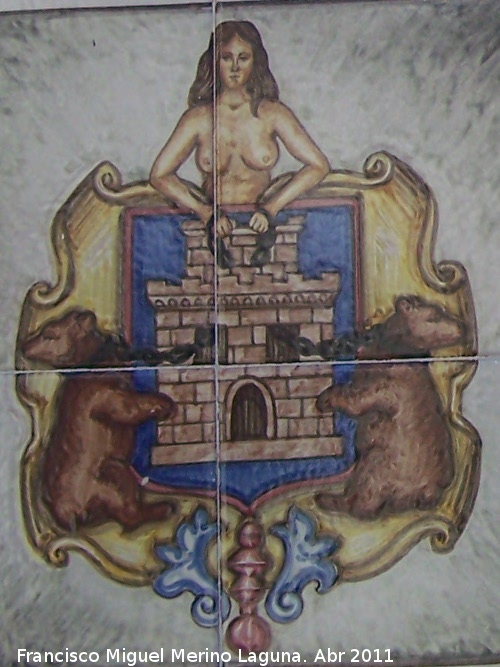
Things begin to make sense, right? The two bears (our little birds), the girl, (actually Ceres, the goddess of agriculture) and a tower which was added much later.
The Roman Empire ended in 5th century; there was a brief Christian period. Different peoples come to Andalusia: Vandals, Suevi, Visigoths (from the centre-north of Europe), Alani (originally from Iran) and Byzantines (Turkish). Then the Muslims enter the Peninsula in 711.

They were the ones who built this tower (Torre del Agua) in Osuna quite a few years later (12th century).
This coat of arms is considered to be the oldest one in Spain. It hides such a long and interesting history that I thought it was something I had to share with you. Believe me if I say that it’s not about that silly-billy thing like “My place is better than your place”. I had to draw a coat of arms and this one was just perfect.
The history of Osuna goes on after what I’ve told you. Many good and bad stories that have made my place turn into what you can see nowadays: A white town, with a street acknowledged by the UNESCO as the second most beautiful one in Europe, surrounded by olive trees… And with no bears any more.
Incidentally, Osuna is so windy that some people say that bears went away because they were fed up with it. What a funny theory!
I hope you’ve enjoyed my stories.
From Osuna, with love,
Pilar.
PS. Thanks to the recent philological study by Juan Collado, now we know that the name of Osuna actually comes from Iberian urso («land of lagoons»).
 Bird: El inglés volando (The secrets of the book!)